


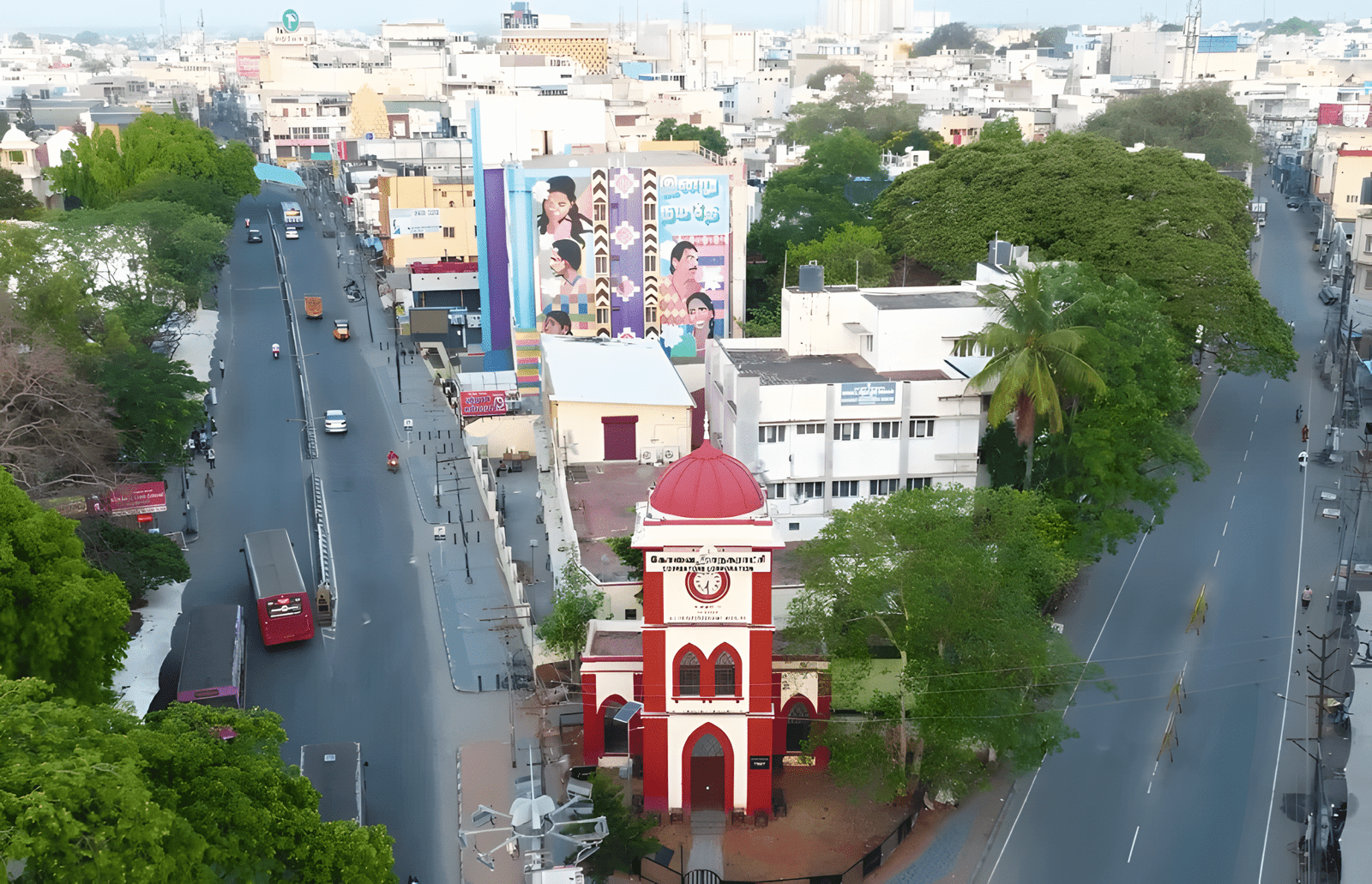
As Coimbatore awaits the 2026 Assembly election results, the city finds itself at the edge of witnessing a shift in its political landscape. Situated in the western belt of Tamil Nadu, Coimbatore has historically been an AIADMK stronghold.
This regional dynamic effectively ties into the broader political structure of the state. Tamil Nadu has long been a Dravidian Duopoly. The two powerful rivals – Dravida Munnetra Kazhagam (DMK) and the All India Anna Dravida Munnetra Kazhagam (AIADMK) have stood the test of time and dominated the political stratosphere of the state for decades.
But now, as the Tamizhaga Vettri Kazhagam, led by Joseph Vijay, enters the fray with significant fanfare, the 2026 assembly elections mark an important shift in the state’s political ecosystem. One that could fracture traditional vote banks and test the limits of Dravidian dominance in the state.
But to understand its potential impact on Tamil Nadu’s future, it is essential to take a look at the players themselves and the electoral promises they are betting on.
The DMK-led Secular Progressive Alliance (SPA):
Established in 1949 and currently led by M. K. Stalin, the DMK is a left-centrist party rooted in the Dravidian ideology of social justice, secularism, and the abolition of caste-based politics. The Secular Progressive Alliance, headed by the DMK, is a coalition formed in 2019 to take on the AIADMK-led coalition – the National Democratic Alliance, which included powerful political parties, including the BJP.
Membership and seat-sharing
The SPA coalition presented an alliance between key national and regional parties such as the Indian National Congress (INC), Communist Party of India (CPI), Communist Party of India (Marxist) (CPI(M)), Viduthalai Chiruthaigal Katchi (VCK), Marumalarchi Dravida Munnetra Kazhagam (MDMK), Desiya Murpokku Dravida Kazhagam (DMDK), and several other smaller parties representing caste and minority interests.
The alliance is contesting for all 234 seats in the assembly elections this time. With regard to seat-sharing, the DMK remained dominant, having contested for 164 seats, followed by the INC, which contested for 28 seats. Other allocations included DMDK (10), VCK (8), CPI and CPI(M) (5 each), MDMK (4), IUML, MMK, and KMDK (2 seats each), while smaller allies such as MPP, TDK, MJK, and SDPI were allotted one seat each.
| Party | Seats Allocated |
| Dravida Munnetra Kazhagam (DMK) | 164 |
| Indian National Congress (INC) | 28 |
| Desiya Murpokku Dravida Kazhagam (DMDK) | 10 |
| Viduthalai Chiruthaigal Katchi (VCK) | 8 |
| Indian Union Muslim League (IUML) | 2 |
| Communist Party of India (CPI) | 5 |
| Communist Party of India (Marxist) (CPI(M)) | 5 |
| Marumalarchi Dravida Munnetra Kazhagam (MDMK) | 4 |
| Manithaneya Makkal Katchi (MMK) | 2 |
| Mukkulathor Puli Padai (MPP) | 1 |
| Thamizhar Desiya Katchi (TDK) | 1 |
| Manithaneya Jananayagan Katchi (MJK) | 1 |
| Social Democratic Party of India (SDPI) | 1 |
| Kongunadu Makkal Desiya Katchi (KMDK) | 2 |
Overview of electoral promises:
In terms of electoral promises, the DMK’s schemes are rooted in dignity and welfare provision, tackling climate change, and incorporating tech into governance. Its flagship schemes like the ₹1000 monthly support for women, expansion of the Chief Minister’s breakfast scheme up to class 8, large-scale job creation driven by ₹18 lakh crore in investments, and a steady push to decentralize growth beyond Chennai, are outlined in the DMK’s manifesto.
The document also talks about integrating climate governance, in terms of mitigating heat waves and structural adaptation, making it stand out for employing one of the most climate-aware approaches in the state’s election history.
The DMK has also promised to launch the single window “Vetri TN Super App” to facilitate state governance by delivering services within 21 days.
Key strengths and challenges:
As the incumbent, the DMK entered this year’s elections with key strengths such as:
- A strong governance record underpinned by robust economic performance outpacing the national average.
- Retaining its structural advantage in northern Tamil Nadu, Chennai, and the central Delta region, where it has historically outperformed rivals.
- Clear ideological positioning, rooted in advocating for state rights, federalism, consistent opposition to Hindi and NEET imposition to protect regional interests.
- Sound grassroots presence and an extensive structural network within the organization.
- Stable alliance structure that helps consolidate votes.
- Tapping into the female section of voters who have traditionally been AIADMK leaning due to the presence of the late J.Jayalalitha, through schemes like the Kalaignar Magalir Urimai Thittam (KMUT), which provides ₹1,000 per month to female beneficiaries, and the much-well-received “Vidiyal Payanam” scheme that provides free bus travel to women.
Key challenges:
- As the ruling party, DMK has been subject to heavy anti-incumbency sentiments and accusations about dynastic politics.
- Despite significant economic investment promises, there have been questions about whether these investments have translated into tangible employment creation for the youth in the state.
- Emergence of a new variable – TVK, with potential to split DMK’s traditional vote banks.
- DMK has consistently been targeted by the opposition parties about alleged corruption and administrative lapses, shifting the narrative from welfare delivery to accountability.
- The party has historically struggled to establish itself in western Tamil Nadu, particularly the Kongu belt, with inconsistencies persisting in the southern region of the state as well.
Regional Importance – Coimbatore:
Coimbatore district, which has established itself as an AIADMK and BJP stronghold, comprises ten State Assembly constituencies: Mettupalayam (No. 111), Sulur (No. 116), Kavundampalayam (No. 117), Coimbatore North (No. 118), Thondamuthur (No. 119), Coimbatore South (No. 120), Singanallur (No. 121), Kinathukadavu (No. 122), Pollachi (No. 123), and Valparai (No. 124), which is reserved for Scheduled Castes (SC).
The DMK fielded key candidates such as V. Senthil Balaji contesting in Coimbatore South, signalling an attempt to consolidate support in the region. While the party’s campaigns in the region focused on welfare provision, industrial and infrastructural development aligned with Coimbatore’s Identity as an industrial hub. Tensions remain high, and the situation is unpredictable as the results approach, as winning this in this region could be key to the party’s westward expansion.
The AIADMK-led National Democratic Alliance:
Once a dominant political contender under the leadership of the late Chief Minister J. Jayalalithaa, the All India Anna Dravida Munnetra Kazhagam (AIADMK) enters the 2026 elections in a state of structural transition, particularly amongst the top brass of the organization. Founded in 1972 by M.G. Ramachandran (M.G.R.), it was originally a breakaway faction from the DMK. The AIADMK has traditionally presented itself as a more pragmatic, less ideologically rigid, centrist party within the Dravidian substructure. It represents a blend of the Dravidian ideology with strong leader-centric populism and centrist social welfare policies (pro-poor).
Membership and seat sharing
Anchored by the AIADMK, the National Democratic Alliance (NDA) has a long, yet turbulent history in Tamil Nadu. The NDA was a primarily bilateral alliance between the AIADMK and the BJP, originally created to secure regional numbers for the 1998 Lok Sabha Elections. This was the entry point for the BJP into Tamil Nadu.
Although this alliance was instrumental for the BJP to gain a foothold in Tamil Nadu and obtain seats to form the union government, this has functioned as a constant on-and-off relationship characterised by frequent fall-outs and reunions between the two parties.
The most recent reunion of the NDA happened quite recently in 2025, to present an unwavering front against the incumbent DMK. Besides the AIADMK and the BJP, the NDA alliance 2025 incorporates smaller regional parties such as the Pattali Makkal Katchi (PMK), Amma Makkal Munnetra Kazhagam (AMMK), and other regional allies.
With regard to seat sharing, AIADMK remained the primary contender, having contested for 167 seats, followed by the BJP (27), PMK (18), AMMK (11), and TMC(M) (5), while smaller allies such as IJK, TMMK, PB, NJP, and STMK were allotted one seat each.
| Party | Seats Allocated |
| All India Anna Dravida Munnetra Kazhagam (AIADMK) | 167 |
| Bharatiya Janata Party (BJP) | 27 |
| Pattali Makkal Katchi (PMK) | 18 |
| Amma Makkal Munnetra Kazhagam (AMMK) | 11 |
| Tamil Maanila Congress (Moopanar) (TMC(M)) | 5 |
| Indhiya Jananayaga Katchi (IJK) | 2 |
| Tamilaga Makkal Munnetra Kazhagam (TMMK) | 1 |
| Puratchi Bharatham (PB) | 1 |
| New Justice Party (NJP) | 1 |
| Singa Tamilar Munnetra Kazhagam (STMK) | 1 |
Overview of electoral promises:
The electoral promises of the AIADMK are centered around themes such as direct income and household support, sectoral support for agriculture, tackling unemployment, health, and infrastructural development.
Its defining initiatives include the provision of a one-time ₹10,000 special allowance for every family to combat inflation, free refrigerators for rice ration card holders, and the provision of three LPG cylinders per household annually, reflecting continuity of the ‘Amma model’ of welfare-driven governance.
The party also pledged to increase guaranteed working days from 100 to 150 days under the MGNREGA scheme, extend free bus travel to men, provide monthly assistance of ₹2,000 for unemployed graduates, and establish an exclusive anti-drug task force to curb contraband.
Key strengths and challenges:
The AIADMK enters this election with key strengths such as:
- A very cohesive, loyal support base in the western region of Tamil Nadu, particularly the Kongu Belt, which has perennially acted as the party’s unassailable bastion.
- Its determined, continued association with welfare schemes through the “Amma model” created by the late J.Jayalalithaa, the party retains its legacy support base.
- The AIADMK, unlike with previous internal struggles, now presents a renewed, united front under an undisputed singular leadership of h Edappadi K. Palaniswami (EPS), their Chief Ministerial candidate.
- Close ties with the BJP help consolidate urban votes
- Positioning itself as the protector of the common man’s cost-of-living, by focusing its campaigns on raising utility costs, law and order concerns.
- Extensive grassroots penetration and support network
Key Challenges:
- For a party based on ideas of centralized leader-centric populism, the absence of a single charismatic leader after the passing of its ex-leader J. Jayalalithaa is bound to hurt. The recent internal struggles and factionalism within the party hinder the presentation of a strong front to the people.
- The emergence of TVK threatens its anti-incumbency vote banks, with some exit polls projecting that this factor could potentially relegate the AIADMK to third place within the assembly.
- The partnership with the BJP remains a double-edged sword. While it may help consolidate some votes, it may alienate minority and secular voters.
- Loss of key allies such as the DMDK, who left AIADMK to join the DMK. This loss hurts because they are a party with state-wide recognition and could have helped tip the scales in favour of the AIADMK in case this turns into a close contest.
- The AIADMK once had a strong grip in the south, but internal factionalism led to the fragmentation of the Thevar community vote in the south. So the waters remain uncertain. The DMK, however, was able to take advantage of this rift and expand its presence in the south.
Regional Importance – Coimbatore:
The AIADMK leveraged its strong supporter base in Coimbatore, a traditional western stronghold for the party in this election. Under the seat-sharing agreement, the BJP was allocated high-profile constituencies such as Coimbatore North, while the AIADMK directly contested with all 7 sitting MLAs in the rest of the constituencies.
The party’s campaigns in this area focused on the”One Trillion Dollar Economy” vision, infrastructural development with an industrial focus, and inflation relief through flagship schemes such as the ₹10,000 family allowance to counter rising utility prices.
Tamizhaga Vettri Kazhagam (TVK) – Independent
A recent addition to Tamil Nadu’s electoral landscape, the Tamizhaga Vettri Kazhagam, led by actor-turned-politician Joseph Vijay, was officially formed on the 2nd of February 2024. Although it is broadly similar to the DMK in terms of ideology and social justice goals, it explicitly distinguishes itself by strongly rejecting dynastic politics and atheism. It is a left-centric party rooted in Dravidian ideologies, Tamil nationalism, and leader-centric populism.
The TVK is primarily viewed as a political disruptor of the 2026 elections. The party has strictly rejected alliances with both the incumbent DMK, which it labelled a “political enemy”, and the BJP, which it termed an “ideological opponent”. Thereby choosing to contest independently for all the 234 seats in the state assembly elections.
Overview of Electoral Promises
The party’s electoral promises are centred on ideas of welfare expansion, tackling unemployment, provision of an educational safety net, healthcare expansion, and tech-based governance. Its flagship initiatives, such as the monthly grant of ₹2,500 for women heads of households under 60 years old and the supply of 6 free LPG cylinders annually, are aimed at improving women’s financial autonomy and combating inflation.
The party also pledged to provide a monthly grant of ₹4,000 for unemployed graduates seeking jobs, and provide a safety net. Its “Tamils First” employment strategy incentivises private firms to ensure 75% local hiring through tax and tariff concessions. The governance framework emphasises digitisation through an AI Ministry and “AI City,” aimed at reducing corruption and ensuring doorstep delivery of services.
Key strengths and challenges:
The disruptive potential of the Tamizhaga Vettri Kazhagam is underpinned by clear structural strengths, but also constrained by equally significant limitations. Its greatest advantage lies in Joseph Vijay’s mass appeal, which has enabled the party to rapidly mobilise urban youth and first-time voters while positioning itself as an anti-establishment alternative to both the Dravida Munnetra Kazhagam and the All India Anna Dravida Munnetra Kazhagam.
However, this momentum is offset by the absence of a deep booth-level organisational network, which remains critical in Tamil Nadu’s electoral system. This is further compounded by the party’s relative lack of political and administrative experience, raising questions about its ability to convert popularity into effective governance and sustained electoral performance. Moreover, its welfare-heavy promises closely mirror those of its rivals, limiting policy differentiation, while its statewide contest risks spreading its vote share too thin to translate into seats. As a result, TVK’s immediate impact may lie less in securing power and more in redistributing it—shaping outcomes indirectly by fragmenting vote banks rather than consolidating them.
TVK’s role as a disruptor:
According to political analysts and exit – poll data, the TVK is positioned as a disruptive X-factor in the 2026 assembly elections. Let’s take a look at why:
- Breaking the duopoly: The TVK has challenged decades of alternating political dominance by the DMK and the AIADMK by choosing to contest for all 234 seats of the assembly independently. It has now successfully positioned itself as a viable third force, forcing the historically bipolar contest into a triangular one.
- Utilizing the youth demographic: Joseph Vijay’s massive youth-based fandom has directly translated into political power, with early polling trends suggesting disproportionately high support among first-time voters. This signals that the TVK has a significant pull on an entire generation of young voters.
- Shifting Campaign Narratives: By pushing for anti-dynastic politics and anti-corruption in governance, Vijay has successfully cornered established political parties such as the DMK and the AIADMK to recalibrate their governance. This has shifted the narrative of these parties, pushing them toward transparency and accountability in governance.
- Vote Share vs. Seat Conversion: Exit poll projections vary wildly, with Axis My India predicting that the TVK would win as many as 98-120 seats while the JVC’s estimates are as few as 8-15 seats. The massive gap in projections exists because TVK needs its voters concentrated in specific areas to win 120 seats, whereas scattered support would result in a high vote share but only 8 seats. Essentially, a high total vote count only translates into power if those voters are grouped together enough to beat the DMK or AIADMK locally.
But who faces greater disruption? – The DMK or the AIADMK?
While both the DMK and the AIADMK are projected to be affected by TVK’s entry, the AIADMK is more vulnerable to TVK’s rise as it occupies a similar political space.
First of all, both of these parties are based on ideas of strong leader-centric populism. But after the death of J. Jayalalithaa, there has yet to be a charismatic political leader anchoring this idea to the AIADMK’s political outlook. The party’s core support comes from a more pragmatic voter base seeking a charismatic leader. The TVK’s surge is taking over this declining AIADMK space, signalling leadership preference for Joseph Vijay exceeding that of Edappadi K. Palaniswami.
On top of that, AIADMK has customarily been on the receiving end of most of the anti-incumbency votes in situations like this. But the entry of the TVK threatens to fragment these votes that would typically consolidate behind the AIADMK. This is one of the core aspects of these elections that makes it highly unpredictable.
In the face of AIADMK’s past leadership struggles, internal factionalism and lowering cadre morale in some regions, it’s voter more susceptible to the fresh appeal of the TVK.
The DMK, on the other hand, does potentially stand to lose portions of its youth and first-time voter base, as well as its loyal Christian voter base. However, its robust coalition model and organizational structure provide a stable base for its vote share. Plus the DMK continues to retain significant support from minority communities and rural women beneficiaries of state welfare schemes. It also stands to benefit from its steady Dravidian ideological approach, acting as a bond for its core voters, placing the DMK at a less susceptible position within the electoral landscape.
But what does this mean for Coimbatore?
The entry of the Tamizhaga Vettri Kazhagam (TVK) has also altered the electoral landscape of Coimbatore district. Traditionally an AIADMK stronghold, the TVK threatens to fragment the vote bank with a powerful youth voter-base in the city.
The DMK has deployed high-profile leaders like Senthil Balaji to claim the region through extensive groundwork and welfare schemes. On the other hand AIADMK has maintained its stronghold strategy by re-fielding all seven sitting MLAs, including heavyweight leaders like S.P. Velumani (Thondamuthur), Pollachi V. Jayaraman (Pollachi), and Amman K. Arjunan (Coimbatore South), to counter the combined pressure from the DMK and the emerging TVK. Meanwhile, TVK candidates such as V. Senthilkumar in Coimbatore South have gained significant momentum by tapping into urban youth and first-time voter segments who are increasingly disillusioned with both Dravidian majors.
Exit polls like Axis My India suggest a major shake-up in the western belt, where TVK’s strong debut could either split the AIADMK’s traditional core or eat at the DMK’s recent local body gains, potentially leading to close triangular contests in several of the district’s constituencies. Ultimately, Coimbatore serves as an important battleground, testing whether TVK’s star power can dismantle established booth-level machineries to emerge as a decisive “third force” in the city.
The final official results for all Coimbatore constituencies will be declared by the Election Commission of India (ECI) on May 4, 2026.

